
As the Crow Flies
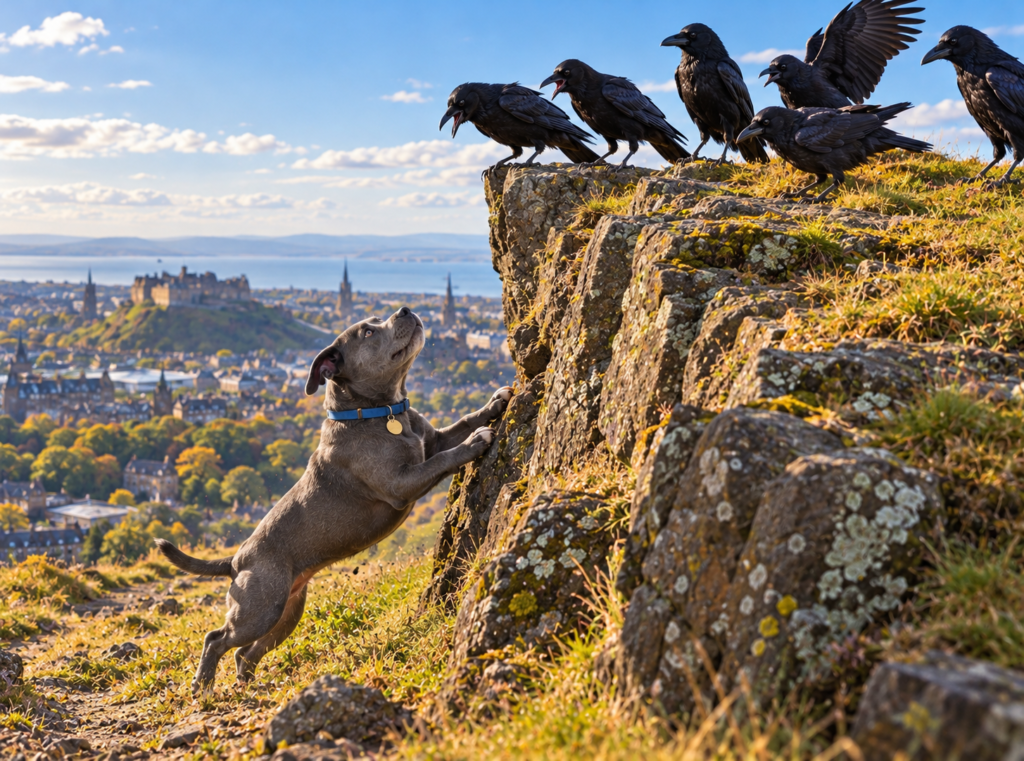
On the evening of 19th July, Janine, Margot and I stood on St Leonard’s Crags and watched Salisbury Crags burn.
Eight hundred square metres of gorse, ablaze. Flames visible across the city. I felt a profound sense of loss standing there — I had become more attached to that particular hillside than I had realised. The place where Margot and I walk every morning. The place where the peregrines nest and the corvids hold court and the thermals rise off the rock face.
On fire.
The next morning we went back. And we came across a man standing alone below the scorched hillside, looking utterly bereft. We went over to check on him.
My crows have all gone, he said.
It turned out he had been coming to this spot for years, feeding the crows peanuts of an evening. They knew him. They came to him. He had built a relationship with them — or perhaps they had built a relationship with him. And now the fire had driven them away and he didn’t know if they’d come back.
I went looking for him a few weeks later. He was there. And so were the crows — all around him, settled and unruffled, as if the fire had never happened.
This is the thing about crows. They are not indifferent to us. They notice. They remember. They form attachments to places and to people that outlast disruption and disaster. A friend told me recently about a young couple she’d seen feeding squirrels in their local park. A crow had clocked what was going on, learned the routine, and started turning up at exactly the right time and place. For this impromptu picnic. No invitation needed. Just crow intelligence, quietly and cleverly doing what it does.
And then there is the pure pleasure of watching them above the crags. Swirling in the updraughts, chasing each other, riding the wind for what seems like the sheer joy of it. Last Monday morning, in a stiff breeze, I watched one crow do a complete 360 degree spin — like a spinning top — before carrying on as if nothing remarkable had happened.
Margot has her own relationship with the crows — though not one they’ve entirely welcomed. She went for one recently. It flew off, picked something up, and as we walked beneath where it had perched, it then dropped an empty vape pen on us. Deliberately, I am certain of it.
Also, when we’re up on the crags they perch on the very edge of the cliff and watch her approach, calling to her, luring and tempting her toward the edge. I have a sense they are like sirens tempting sailors onto the rocks.
The sirens knew exactly what they were doing.
And so do the crows.
I kind of admire them in a menacing kind of way.
The Michaelmas Daisy
This time last year, when Janine and I first moved to Edinburgh, we joined a ranger tour around Salisbury Crags. The ranger was telling us how the area between Arthur’s Seat and the crags was used as a rifle range by the Queen’s Edinburgh Rifles. As we walked I spotted a circular feature in the ground and, emboldened by the military talk, I asked — is that a gun platform?
No, came the reply. That’s a patch of Michaelmas daisies. And that particular patch has been slowly migrating up the valley for years.
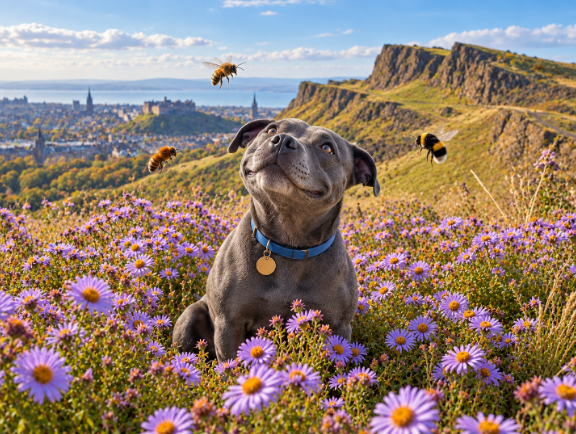
So, this week Margot and I went looking for them. Our walks are not usually guided by a destination — regular listeners will know we prefer to perambulate, to go where the breeze takes us — but this one had a purpose. After a bit of off-roading we found it. A thick, dense bed of purple daisies, with upright stems surrounding it on all sides.
The Michaelmas daisy — or aster, from the Greek for star — has lilac purple petals surrounding a bright yellow centre. It spreads outward from a central clump, with the oldest growth dying back in the middle and new life appearing at the edges. Year by year the ring expands and the whole colony walks slowly up the hill.
To be honest, it looked like a big pile of dead weeds.
Well. I’d found it, I thought. Now what.
I stopped. I looked.
In that brief lull, with Margot pulling at the lead, I noticed what was working the daisies. A honey bee. A carder bee. A bumblebee. All three moving between the purple stars, unhurried and absorbed. One of the last great pollinator feasts before the season turns.
I thought the Michaelmas daisy was a rarity, reserved for the crags. Turns out I’ve found it everywhere. Garden borders. Cracks in the pavement. Waste ground. They were always there. I just hadn’t been looking. Like I said a bit of a weed.
Michaelmas itself — the feast of St Michael the Archangel — falls on the 29th of September. In Scotland it was historically one of the most important festivals of the year. In the Hebrides it was marked with horse racing, feasting, and the baking of a special harvest cake called struan Micheil, made from that year’s grain. And there was a tradition of giving a Michaelmas daisy as a gift — because its colours, it was believed, offered protection against the advancing darkness of autumn and winter.
There is also a tradition, observed in Scotland and Ireland, that you should not pick blackberries after Michaelmas. The reason given is that Lucifer, cast out of heaven on that day, landed in a bramble bush and spoiled the fruit by spitting on them.
Margot, as ever, was unimpressed. She likes nature on her own terms.
The light is changing. The evenings are drawing in. The daisies know.
The season is turning on its hinge.
May's Maple
This week Margot and I have been doing some sprucing up in the top tier of the church. A good hoover and a dust. I should say I’ve been doing the sprucing — Margot has taken violent umbrage at the vacuum cleaner hose and attacks it every time it’s switched on. Which does slow things down but amuses me no end.
During the meanderings up there my curiosity caused me to stumble across a file about the bicentennial celebrations of 1976. Two hundred years of Unitarian presence in Edinburgh. The congregation, wanting to mark the occasion, decided to plant some trees in Berwickshire — where Edinburgh Unitarianism has its origin story. After several old school letters back and forth with Berwickshire Council, a location was agreed. A lay-by picnic area on the A1 near Auchencrow. Native ash, oak and birch were planted there.
There are no photographs in the archive. No maps. No record of anyone ever visiting the trees. They simply planted them, and left them to grow. Good ancestors, doing quiet work that none of them would live to see come to fruition.
Roman Krznaric writes in his book The Good Ancestor that the most meaningful thing we can do is think beyond ourselves — to make decisions and leave things behind that serve people we will never meet. The congregation of 1976 didn’t need photographs. They weren’t planting trees for themselves — they were preparing for the next generation of citizens and picnic goers.
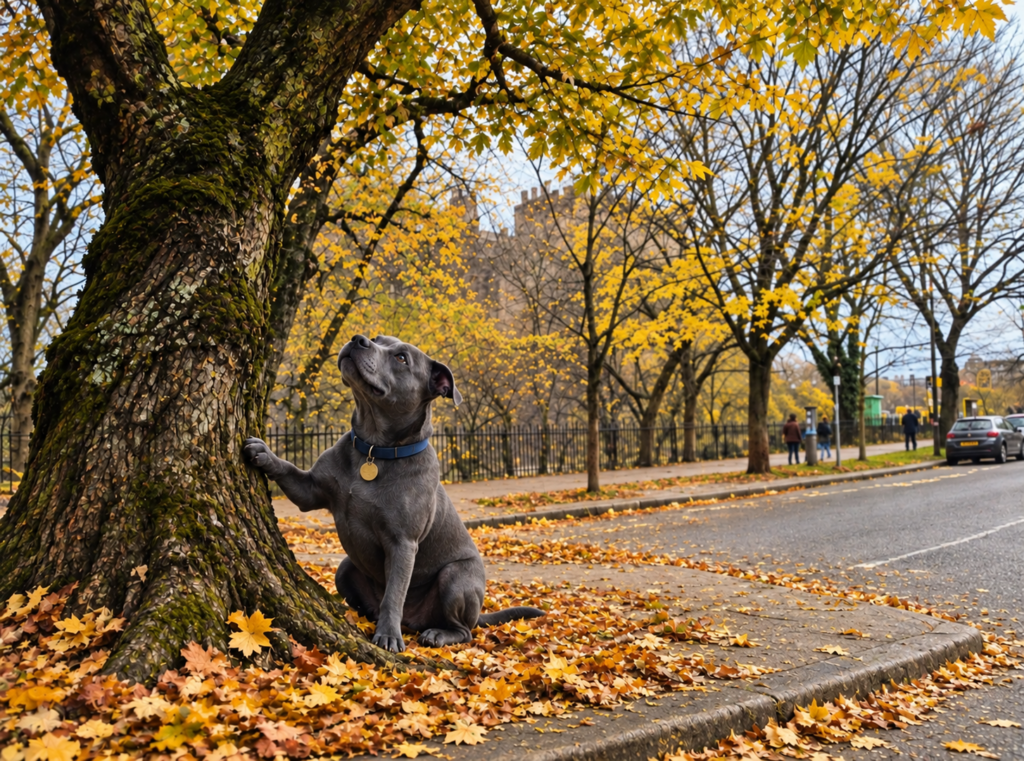
Going through the archive in a shoe box I found a black and white photograph. There was a group of people outside St Mark’s, gathered around a sapling which was being planted. I was very impressed with the shiny spade held by a slightly elderly lady in a dapper coat. From the cars in the background I’d place it somewhere in the 1980s — XR3i and Ford Granadas. The tree was a maple, planted in honour of May Crawford — a lifelong Unitarian and devoted member of this congregation. I don’t know much about May yet. But I’m asking around. If you know anything about May please feel free to share.
What I do know is this — May’s maple is still here. Step outside the front door, look to your two o’clock, and cross the road. There it is. We have probably walked past it dozens of times without knowing whose memory it carries or whose love planted it. Rest your hand on the tree and you can reconnect to 40 years of history.
Two hundred and fifty years in Edinburgh. Trees in Berwickshire that no one went back to visit. A maple for May, still growing across the road.
This congregation has always understood something important. That the most powerful thing any of us can do is plant something we will never sit under. To leave behind what others will benefit from, people we may never know, in a future we will never see.
Plant the tree. Be a good ancestor. Be the legacy you want to see in the world
A Murder, A Conspiracy and A Mischief
Wednesday morning found Margot and I on our favourite grass mound below Salisbury Crags. It’s my favourite spot. Margot is largely indifferent.
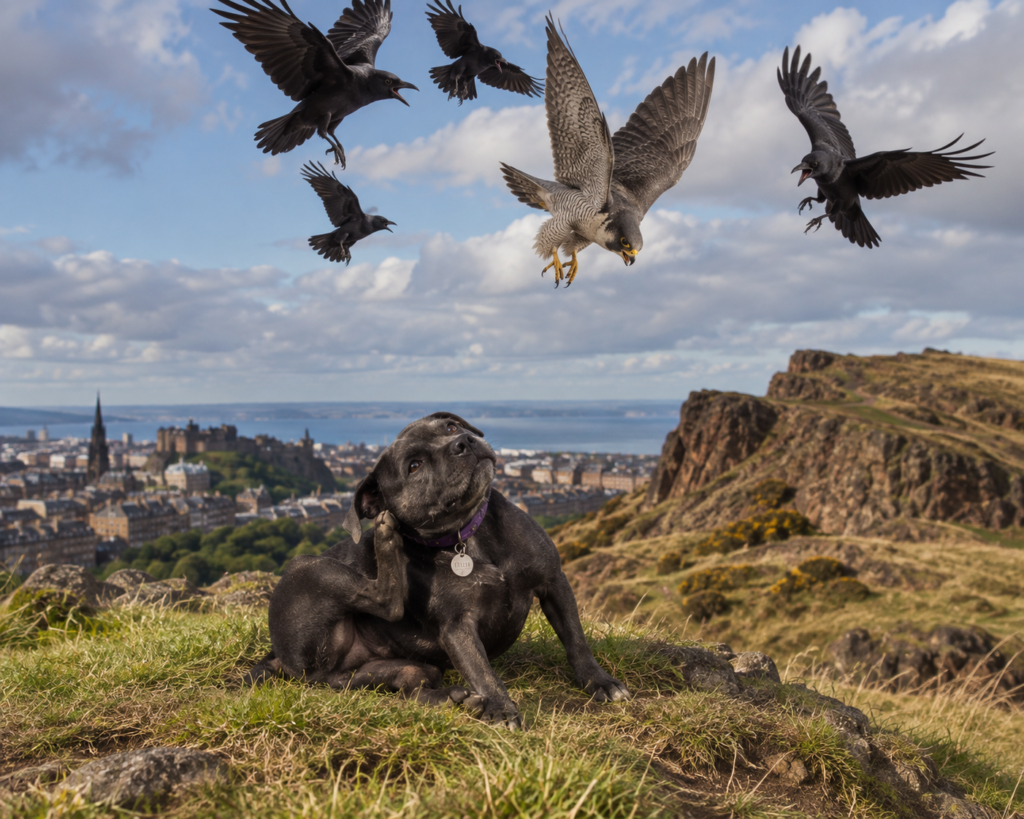
Looking back towards Arthur’s Seat I noticed the corvids were up to something. Big black birds wheeling and diving in the sky — crows, jackdaws, ravens, magpies. Mostly indistinguishable from each other at that distance, apart from the magpies. I’ll call them corvids, because that is their family name. And corvids have a dark reputation, as you can tell from their collective nouns. A murder of crows. A clatter of jackdaws. A conspiracy of ravens. A mischief of magpies.
This corvid collective were on a mission. A mobbing. And whatever they were after, the magpies in particular were not for backing down — shepherding it, harassing it, driving it steadily down the crags towards where I was sitting. Where I got my first confirmed sighting of a peregrine falcon.
I knew there was a family of peregrines living on the cliff. I’d been finding mounds of pigeon feathers — the peregrine’s preferred prey — for months. But I’d never seen one up close, until a corvid collective delivered it directly to me.
The peregrine is the fastest animal on the planet. In a dive it can reach 200 miles per hour. It is an apex predator — capable of taking corvids clean out of the air. And yet it shares its cliff face with them. Nests within feet of them. Raises its young alongside theirs.
Which raises the question — which one is the bad neighbour?
The answer, as it turns out, is both of them. And neither. Ecologists have a term for this — spatial coexistence. Two species competing for the exact same limited resource, in this case prime cliff ledges on a vertical face, managing to partition the space rather than drive each other out entirely.
And then it gets more complicated. Ecologists also call it intraguild predation — two species that compete for the same space while simultaneously acting as predator and prey to one another. The peregrine could eat a corvid. The corvids will raid a peregrine’s nest and eat its eggs if the parents leave them unguarded. Neighbours, rivals, and occasional enemies — all at once.
The mobbing is the corvids’ answer to this tension. By swarming the falcon the moment it takes flight, they advertise that the element of surprise is gone. A peregrine hunts by speed and stealth. Remove the stealth and you’ve neutralised the threat. The corvids know they’re stronger together — putting aside individual differences in the face of a common danger.
And here is the twist — smaller corvids sometimes deliberately nest near a peregrine precisely because the falcon aggressively drives off larger predators. The corvids tolerate a dangerous neighbour because that neighbour inadvertently keeps worse ones away.
Uneasy. Necessary. Mutually grudging.
Margot, meanwhile, was oblivious to all of it. Though thinking about it, a murder, a conspiracy and a mischief describes her behaviour on a bad day rather well.
Some of us were witnessing one of nature’s more complex relationships. Some of us were having a scratch.
Dùthchas
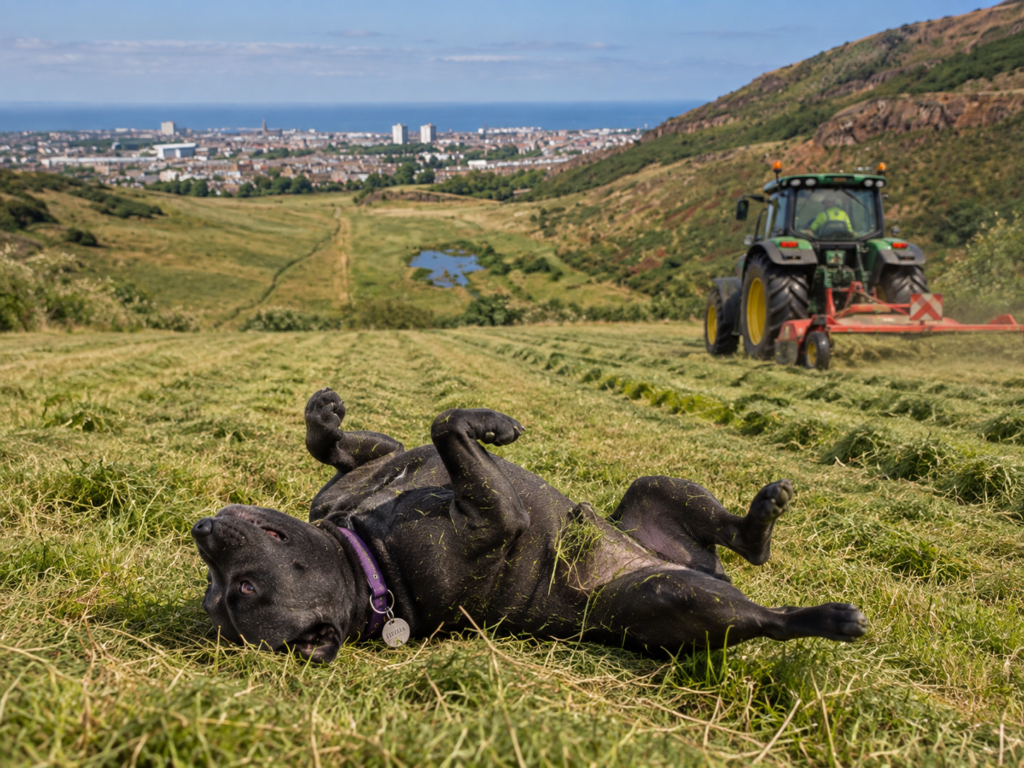
Walking in Holyrood Park this week I came across a tractor cutting and collecting grass on the open ground below Hunter’s Bog. It seemed an unlikely place for a big lawn mower — no obvious paths cross the land, and the wild grass was too long for a football pitch or bowling green.
They weren’t prepping for a new pitch. They were intentionally impoverishing the land.
Cutting meadow grass late in the season and removing what’s cut is one of the most important things you can do for wildflower biodiversity. Wildflowers don’t thrive in rich soil. They thrive in poor soil, the kind that coarse grasses and nettles don’t dominate. By cutting and taking the grass away, you remove nutrients from the ground year by year. Plantlife describe it as simulating the effects of wild grazing — reversing centuries of nitrogen build-up. The soil gets poorer. And as it does, the rare plants get room to breathe.
Hunter’s Bog is a Site of Special Scientific Interest. Walk slowly through it and you’ll find northern marsh orchids, yellow rattle, and — if you’re lucky and careful where you put your feet — adder’s tongue fern. A strange, ancient-looking plant like something from a Jurassic forest floor, growing in such numbers that a botanical survey there found the botanists had to take care not to stand on them. These are not common plants. They are here because someone, for generations, has been paying attention.
There is a Scottish Gaelic word I’d like to introduce — dùthchas (DOO-khus — the “th” is silent, and the “ch” makes that soft guttural sound you hear in the Scottish word “loch.”. It describes a relationship with the land based not on ownership but on continual stewardship. It carries within it the idea that the land belongs to the generations who will come after us as much as to those living now. It stresses our interconnectedness with the living environment — not what we can take from it, but what we owe to it. Today the word is used by environmental movements seeking to restore and care for the Highlands. But the concept is ancient.
The tractor driver below Hunter’s Bog was practising dùthchas without, perhaps, knowing the word. Doing slow, unglamorous, necessary work for the benefit of plants and insects and future visitors.
There is also a plant worth mentioning — yellow rattle. It grows in meadows by quietly parasitising the roots of coarse grasses, weakening them and making space for wildflowers to establish. It is sometimes called the meadow maker. A plant that creates room for others by gently undermining what dominates.
To be a good ancestor — which is what this service asks of us — is perhaps something like this. To do the work that won’t be recognised. To take away what is surplus so that what is rare can flourish. To make space rather than fill it. To tend the ground so that what follows can flourish.
Margot, snuffling through the long grass below the bog, was conducting her own survey. She found nothing of botanical significance. But she does love a good roll around in cut grass.
Dùthchas. To be a good ancestor. To be a steward for what follows.
Chill, I'm Just Passing Through
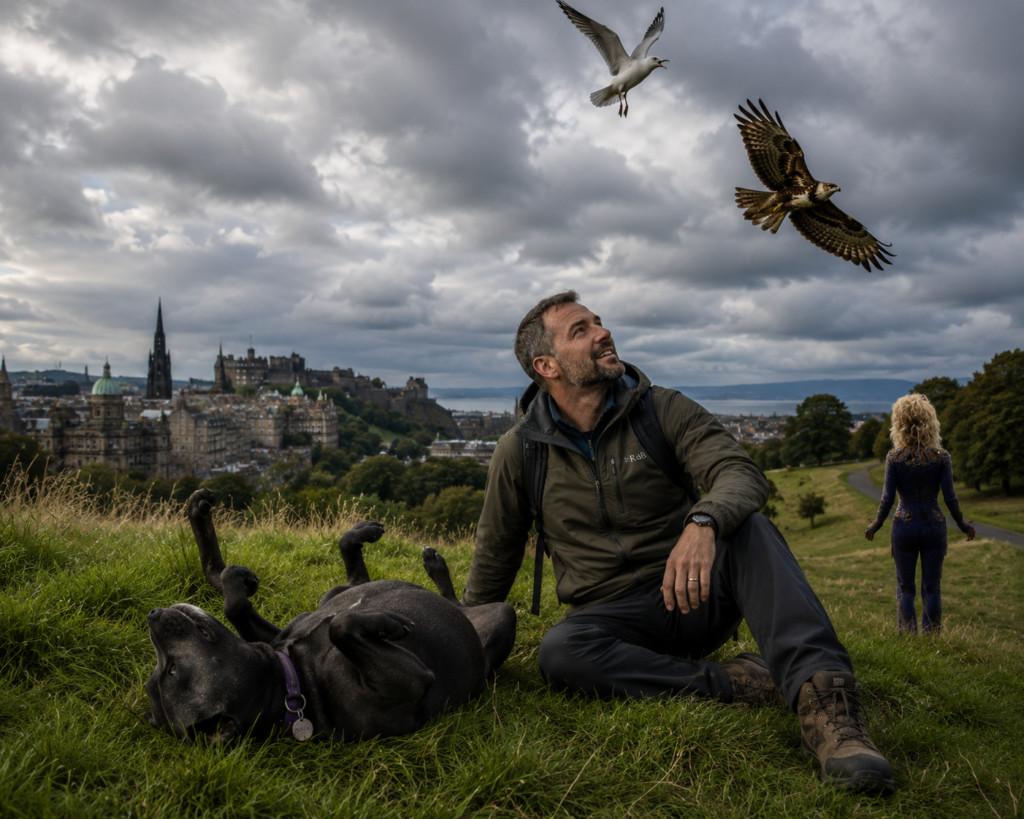
There’s a small grass hillock just off Queens Drive where Margot and I like to stop. It’s not a dramatic viewpoint — no sweeping panoramas, nothing to write home about. It’s just a small fold in the land where Margot can roll around in the grass, body-slam me with a game of tug of war, and I can sit and pay attention to whatever’s unfolding.
On this particular morning what was happening, loudly and insistently, was seagulls.
I should say — there is no such thing as a seagull. It’s a catch-all name we give to those large white birds that steal your chips and thrive on landfill sites. What we actually have are herring gulls, lesser black-backed gulls, common gulls and several others, each distinct, each with their own character. I’ve been somewhat obsessed with them recently. They are birds that make a disproportionate amount of noise, which I find oddly admirable.
But the noise that morning was different. More urgent and strident. And glancing up I saw why — a solo herring gull was having a right proper to-do with a buzzard, high above Queens Drive. The gull would dive in, the buzzard would tilt and avoid. Then the buzzard would wheel back. Then the gull again. It had the quality of aerial tig — neither quite committing, neither quite backing down.
This behaviour has a name — mobbing. It’s what birds do when a larger predator enters their territory, particularly near nesting sites. The gull sees the buzzard not as a passing stranger but as a threat — to eggs, to chicks, to everything that matters. This wasn’t a full mob either — just one bird, alone, having a go.
Now I’ve never heard of a gull tumbling out of bed and stumbling to the kitchen. But this particular gull had clearly poured itself a cup of ambition. Dolly Parton — who we lost this week — taught us that you can come from nothing, take on something considerably bigger than yourself, and refuse to step aside. That’s precisely what this gull was doing. One bird, punching well above its weight class, on nothing but nerve.
The buzzard, for its part, seemed entirely unbothered. As the sun caught its wings at an angle they flashed mirror-silver, tilting away with an almost lazy elegance. The message was clear enough.
Chill. I’m just passing through.
A buzzard over Edinburgh is not a common sight. They are birds of open moorland and woodland edge, not city skies. To see one hanging above Holyrood Park, catching thermals above the crags, is a small privilege. They tend to appear and then drift on, following their own quiet itinerary, indifferent to the fuss being made around them.
The gull eventually gave up. The buzzard tilted once more, caught a thermal, and was gone.
Now Margot isn’t averse to a bit of mobbing herself. I’ve had my arms nearly wrenched from their sockets by her going after a gull on the ground. She hasn’t caught one yet — and given that they live largely on street buffet, probably not the healthiest of snacks. But you’ve got to admire the ambition.
Sometimes all any of us can do is keep stumbling forward and drink that cup of ambition.
The gull knew it. Dolly knew it. Margot definitely knows it.
The NHS and the Alder
(they improve things for everyone, and everything which follows)
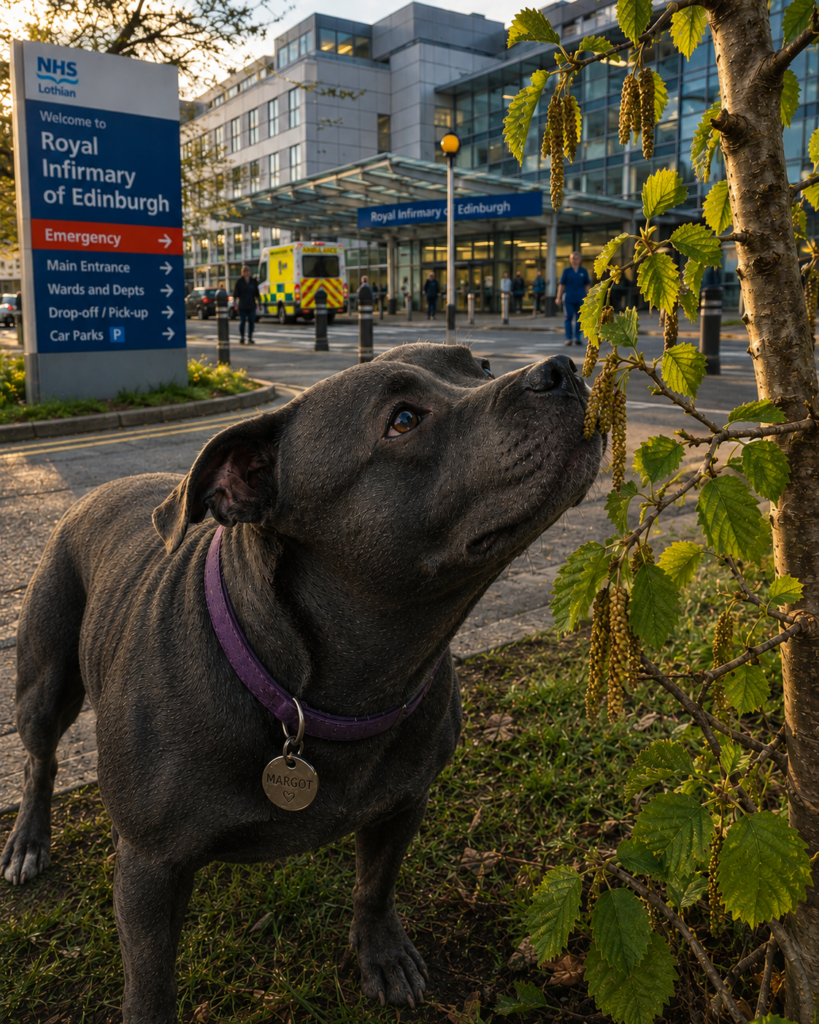
Wednesday morning took an unexpected turn. Janine, Margot and I found ourselves at A&E after Janine decided to test both the laws of physics and the capacity of the human body to absorb damage by coming off her bike at speed. It turns out — not very well. The Scottish NHS, however, was magnificent.
Margot came along for the ride. She’s supportive like that.
In between bouts of excellent care I took Margot for a walk along the hospital’s wellbeing path. And it was there that my squirrelly mind spotted some small fresh green cones overhead and announced, to no one in particular — alnus glutinosa.
I know that sounds like a Harry Potter spell. It is in fact the Latin name for the common alder. Before my incarnation as a police officer I was a tree surgeon, where I rather geekily decided to learn the Latin tree names.
The alder is not a showy tree. You’ll find it in the damp, unglamorous places — riverbanks, streamsides, boggy ground, the scrubby wet edges of things. Dark grey fissured bark, rounded leaves with a slightly sticky texture — which is what glutinosa actually refers to — and small woody cones that look faintly out of place on a deciduous tree. Which is because they are. The alder is the only British native deciduous tree to produce cones. One of a kind.
Like clover, which I mentioned a few weeks ago, the alder has a remarkable relationship with nitrogen-fixing bacteria in its root nodules. A bacterium called Frankia alni lives there, pulling nitrogen directly from the air and enriching the soil around the tree as it goes. The alder doesn’t just grow in difficult ground. It improves it for everything that follows.
The ancient Celts knew the alder well — and they knew it bled. Cut or strike the wood and it turns from white to a deep reddish orange, as if wounded. Celtic warriors crafted their shields from alder for precisely this reason, believing the wood carried a protective spirit — that the shield would bleed in their place.
Coming down to more earthly matters — alder was the traditional wood for clogs, I still remember working clog factories where I was brought up in Yorkshire. Alder doesn’t split when nailed, wears surprisingly well, and doesn’t rot when wet. For a working person on their feet all day in damp conditions, it was the obvious choice.
As I mentioned after being a tree surgeon I was a copper. After being hit by and nearly killed by a car. I set myself two rules. Never leave the house on an argument. And never wear raggedy underwear. You never truly know what’s around the corner.
Even if you’re taking that corner at speed on a push bike.
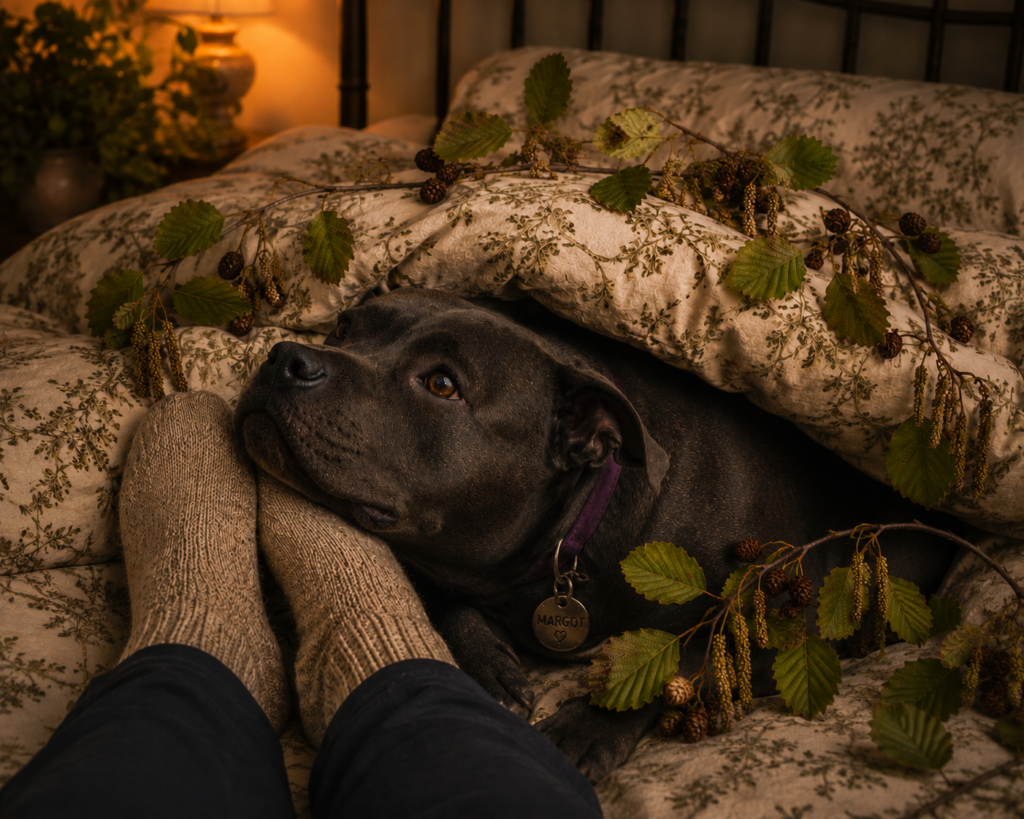
Janine is home now, convalescing. Margot, sensing the situation with the emotional neediness only a staffie can muster, has not left her side.
Some of us guard with Celtic shields. Some of us guard with four legs and a warm chin resting on the duvet.


Total Eclipse of the Heart
(In remembrance of Bonnie Tyler who died this week)
Tuesday evening found Janine, Margot and I sitting below Salisbury Crags waiting for the eclipse. All around us people were milling about, finding their spots, orienting themselves towards the sun. A kind stranger nearby lent us some eclipse glasses — we had, it must be said, come magnificently unprepared.
And so we waited. And as we waited I kept noticing herring gulls flying in front of the sun, silhouetted through the dark glasses. Which drew my attention to a larger group of gulls nearby — and they were doing something distinctly odd. They weren’t gliding in that easy, unhurried gull-like way. They were stopping mid-air, drawing their wings in, changing direction sharply, dropping suddenly and then flying on.
I began to wonder. Was this eclipse behaviour? Were the gulls disoriented by the failing light, their ancient instincts scrambled by something they had no framework for? Was I — and I want to be careful with my words here — watching gulls forget how to fly? It felt like something out of Arthur C Clarke’s Mysterious World. Or Tales of the Unexpected.
Janine, sensibly, headed home after the peak. She had a council meeting to go to. Margot and I carried on. The gulls were still at it — dozens of them now, spiralling in a great loose swirling tornado, others dropping to the ground and pecking urgently at something unseen. I assumed a dropped kebab. We all know seagulls like a bit of road buffet.
But getting closer there was no kebab. On closer examination there were flying ants. Thousands of them lifting from the ground in clouds. Flying ants emerge on warm, humid days when conditions have improved on the previous day — a warm spell following cooler weather is the trigger. The brief temperature drop of the eclipse followed by returning warmth may have been the precise signal the ants were waiting for. The eclipse potentially calling them forth. Or perhaps just a coincidence. Nature doesn’t always explain itself.
The gulls weren’t confused at all. They were doing what gulls do when flying ants appear — diving, wheeling, gorging on an unexpected and abundant snackettes. Every manoeuvre I’d interpreted as disorientation was in fact precision. Every sudden drop was a catch. And here’s where it gets even better — scientists from the British Trust for Ornithology believe that flying ants contain enough formic acid that eating large quantities may actually make gulls drunk. The erratic flying, the sudden drops, the general air of chaotic enthusiasm. They weren’t baffled by the eclipse. They were getting quietly blotto above Salisbury Crags.
I had gone out looking for an eclipse and found something else entirely. I had concocted a mystery — gulls driven mad by celestial mechanics — when the truth was stranger and more ordinary and more wonderful. A warm evening. A cloud of ants. Hungry gulls getting on with it. And possibly getting a little bit tipsy in the process.
Mary Oliver said pay attention, be astonished, tell about it. She didn’t say your first explanation would be right. Sometimes paying attention means watching your own assumptions dissolve in front of you and finding something better underneath.
Margot was unmoved by the whole eclipse thing. No unusual behaviour to report. She was, I think, just happy sitting about on the grass for an hour and having a roll about.
Which, when you think about it, is a perfectly reasonable response to a celestial event.
Marg-I-cal Mystery Tour
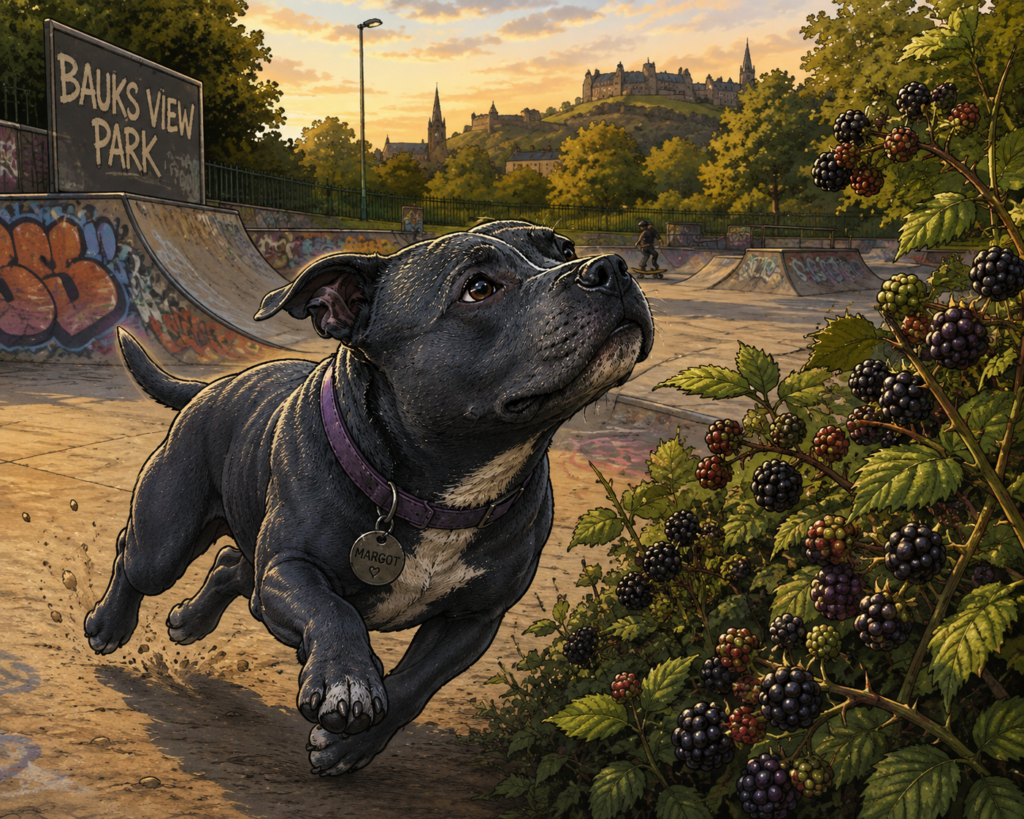
Just recently when Margot and I have gone out I let her lead the way. I call this the Marg-I-cal Mystery Tour. I roughly know where we’re going and how long we have — with me leading our walks have become a bit samey. Same paths, same order, same destinations. So occasionally I hand over the navigation to a staffie and see where our perambulations take us.
What happens, it turns out, is that you end up visiting and noticing the ordinary. And the ordinary, it turns out, has been waiting patiently for you.
Last week she led me onto Bauks View Park behind Dumbiedykes. Bauks is an old Scots word — Walter Scott used it — for an uncultivated strip of land left between fields. A perpetual nursery of weeds, as one old agricultural writer put it. Which, as descriptions go, is not entirely flattering — and entirely appropriate for this park. But walk there and you’ll find the hinterland, the backwaters, the marginal places where nature does exactly what it wants without asking anyone’s permission.
Margot is particularly drawn to the local skate park — goodness knows why, she doesn’t like humans on wheels — which has short looping paths that go up and come back down and arrive more or less where they started. No destination. No purpose beyond the path itself. I wouldn’t normally follow them. But she did, so I did. I often find myself wondering what she is following — what instinct, what invisible thread, what her nose was telling her that my eyes couldn’t see. How she makes her choices. What hidden map she’s reading.
It was on one of those purposeless loops that we found the blackberries. The first of the season, dark and heavy on the bramble, earlier than you’d expect. It turns out this year’s blackberries are very early across Britain — record breaking heat in late May plus drought conditions have stressed the plants and accelerated the fruit growth. The season has rushed ahead of itself to keep up. One forager described it as plants entering a kind of survival mode, fruiting early in response to conditions they weren’t designed for. The early abundance feels like a bonus abundance. But there’s a rushed urgency underneath it.
The thistles tell a similar story. I’d watched them come into flower only weeks ago — purple and bold and full of themselves. And now they’ve already turned to thistle down, the seeds lifting and drifting on the air — “like silvery butterflies at play” as the poet Harold Monro put it. Each one seemingly purposeful, seemingly going somewhere, following a path only it can see. Monro continues — “it is a majestic thing to see how large their destination can be.”
The seasons are passing just as they should. But this year they seem to be passing fast. Or is that just me — noticing.
There’s something in Margot’s navigation I keep coming back to. She just follows what pulls her — nose down, ears up, fully present to whatever the next moment brings. And somehow we find the blackberries, the unexpected path, the things I might have walked straight past. She treats everything she encounters as if it deserves her full attention.
Which, of course, it does.
Maybe that’s not such a bad way to move through the world. To loosen the grip on the destination occasionally. To follow the instinct rather than the plan. To take the looping path that goes up and comes back down and see what you find on it.
The thistle seeds don’t know where they’re going either.
And yet here they are, carrying everything they need for what comes next.
The Lady of the Mountain
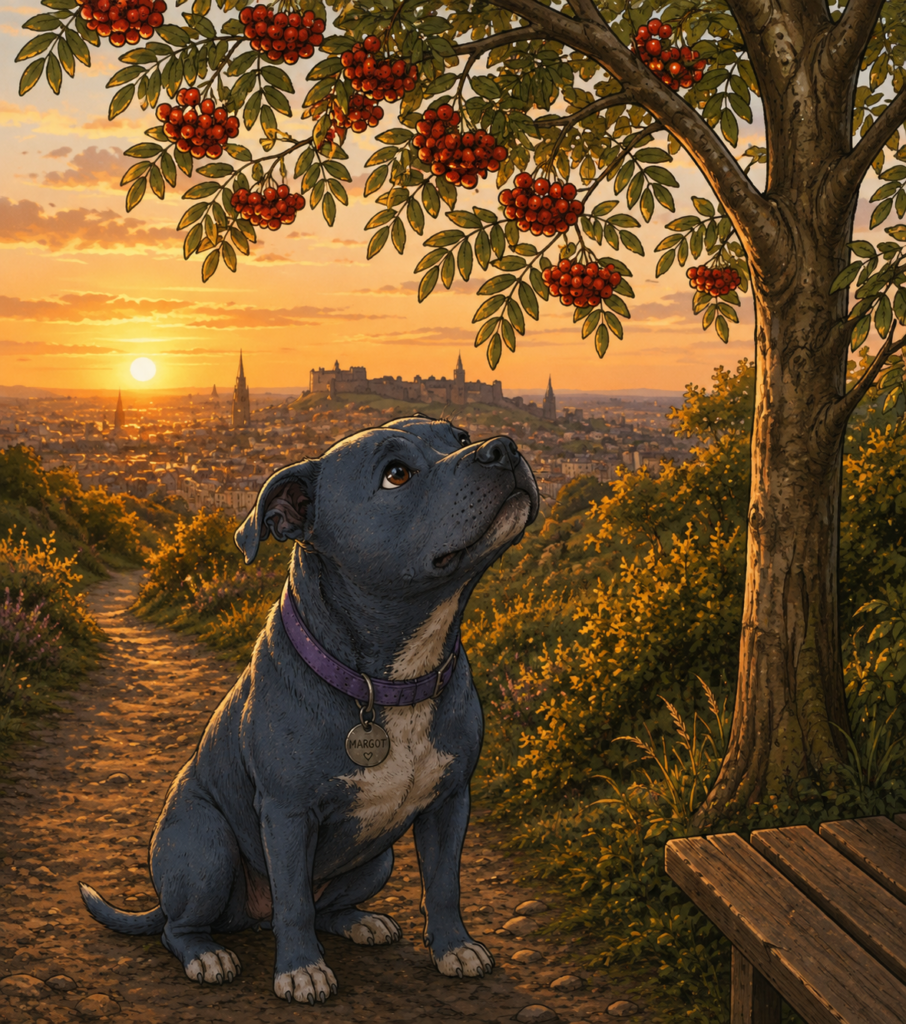
Walking to work yesterday morning I passed a rowan tree and noticed that its berries were just beginning to redden. Summer is quietly, unhurriedly on the turn.
In case you’re not sure what you’re looking for — the rowan is slender, silver-barked, not especially tall, with long feathery leaves a bit like ash, hence the name mountain ash. It is sometimes called the Lady of the Mountain — slight, gnarly, tenacious, growing at higher altitudes than almost any other British tree. In spring it covers itself in clusters of tiny creamy white flowers. And then, right about now, it produces these heavy drooping bunches of berries, starting green and slowly blushing to a deep, vivid red. You’ll have seen them. They’re everywhere at this time of year if you know to look. The town wears its uniform quietly but proudly.
The reddening berries are a reliable signal that the year is on the turn. I noticed this week that the evenings are drawing in a little darker too. And the rowan berries always take me back to the end of the summer holidays. New shoes. New uniform. The slight dread of it. I used to pick the berries off the trees on the way to school and throw them at my sister. Yes, I was that annoying.
This week we mark Lammas — the first of August, the first of three harvest festivals. Everything is poised and waiting. The season of ripening, of watching the sky, of things slowly becoming what they were always going to be. The grown-up version, perhaps, of that back to school feeling — the year turning, something ending, something new about to begin.
Last night walking with Janine and Margot I discovered that our estate has not one rowan tree but five — all within thirty metres of the flat. Two of them even have names of a sort — little metal plates hammered into the bark reading G296 and G297.
In Celtic tradition the rowan was the tree of protection above all others. So sacred in the Highlands that there was a strict taboo against cutting it down. On Lammas Day itself, rowan crosses were placed above every door and window of a house — but only by someone forbidden from speaking to anyone they met on the way. The rowan was believed to protect the household, the livestock, and the land from harm.
With five of them within thirty metres, our flat must be among the most spiritually protected properties in Scotland. G296 and G297 have no idea of the responsibility they’re carrying.
The rowan was also the sacred tree of Brigid — Celtic goddess of healing, poetry, and craftsmanship, and around these parts much beloved. Her staff was made of rowan. Her arrows of rowan wood were said to burst into flame when fired. Spindles and spinning wheels in Scotland and Ireland were traditionally made from rowan — a fitting wood for the patroness of making and the arts.
As a child throwing berries at my sister, I had absolutely no idea. Though I like to think the protection held anyway.
The blackbirds knew none of this either. I remember watching them mob the rowan in Mrs Dinsdales garden next door every autumn — dozens of them, urgent and purposeful, stripping the berries before the season moved on. They weren’t waiting for optimal conditions. They just showed up when the red appeared and got on with it.
Which is perhaps what Lammas is asking of us too. The berries are reddening. The season is turning. The harvest won’t wait forever.
Show up. And get on with it.
Roll Me Over in the Clover
Last week Janine, Margot and I were up in Amulree, a small village between Aberfeldy and Crieff, visiting a graveyard where my ancestors are buried. We decided to explore a little and walked around the nearby loch. As we walked I became aware of a really sweet smell in the air — and looking around I realised we were completely surrounded by white clover. A whole field full of it.
If I’d known then what I know now about clover in Celtic folklore, I might have paid even closer attention. Clover’s role in keeping fields fertile and livestock healthy made it a plant associated with abundance, prosperity and the wellbeing of the land. And in Celtic tradition, meadows and wild places were understood as thin places — spots where the boundary between this world and the Otherworld becomes permeable. The Otherworld itself was described as a realm of everlasting abundance, where ancestors dwelt. Standing in that field, surrounded by clover and nearby graves of people I’m descended from, something felt quietly connected. The clover feeding the soil. The soil holding the dead. The land feeding the living.
Now there is something very special about clover. Farmers figured out centuries ago that rotating clover with other crops meant the soil stayed rich without needing to rest. Tiny nodules on clover’s roots pull nitrogen directly out of the air and return it to the ground as natural fertiliser — no factory, no chemicals, no cost. Just clover, doing what it’s always done, giving back to the ground it grows in. By the 18th century this had helped transform farming across Europe and fed a continent. Not bad for something most people walk straight past.
With clover, three is the magic number. Or is it four? Clover’s three leaves gave it its Latin name Trifolium, and drew it deep into myth and tradition. The Druids held three as sacred and believed the three-leafed plant could ward off evil spirits. St Patrick used that same shape to explain the Holy Trinity to the pagan Celts. And a four-leafed clover — one in five thousand — was said to let the finder see fairies and detect the presence of spirits.
In Scottish folklore clover was used as a painkiller, but only powerful if picked in silence and with the left hand. Sounds like someone was having a joke there.
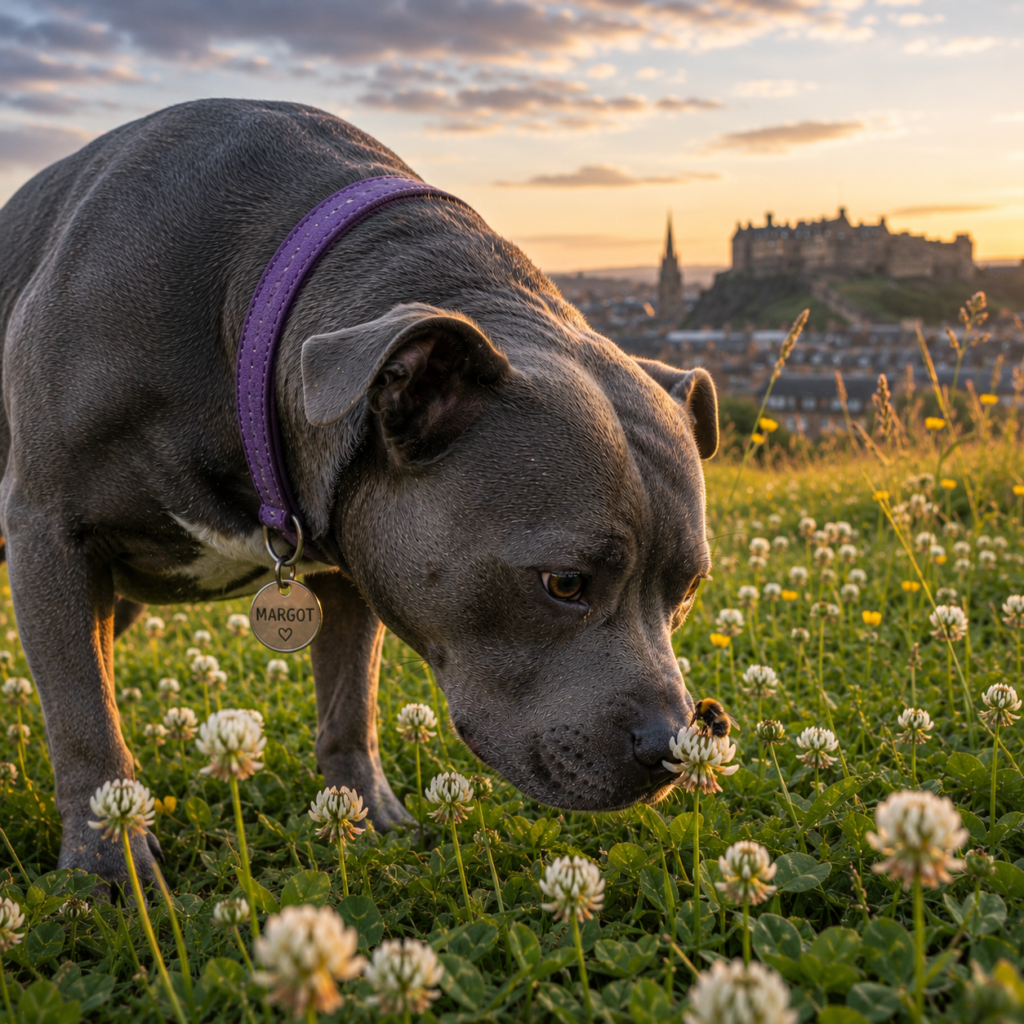
Edinburgh that same week had its own clover moments. On a night out with Margot I spotted a little brown bumblebee snuffling busily inside a clover head. The final clover moment was when Margot body-slammed me and I ended up face down, eye to eye with a clover.
From that undignified vantage point I got what you might call a poet’s eye view of clover — because a poet’s eye is really just a slow eye, one that stops and looks at what everyone else walks straight past. And what I saw was extraordinary. What looks from standing height like a simple blob of white flower is actually dozens of tiny individual tubular blooms, all packed together into one perfect globe. A whole community of flowers in a single head, each one doing its work.
But back to that bumblebee. Clover honey is considered among the finest there is — delicate, sweet, slow to crystallise. Flower by flower, that bee was simply showing up and doing its thing.
Which is, when you think about it, all any of us can do.

Slower
Last night I went for a walk on St Leonard’s Crags. And for those of you who don’t live in Edinburgh — the haar was in.
For a bit of context, the haar is the sea fog that rolls in off the Firth without warning and gives the impression that the city has shifted backwards through time. It doesn’t arrive dramatically. It just appears, quietly, and suddenly the world is smaller and closer and somehow both muffled and sharpened at the same time. Even Arthur’s Seat — that ever present presence — disappears in a cloak of cloud. Robert Louis Stevenson described the haar as “meteorological purgatory” — I don’t know, I kind of quite like it.
The whole place had the feel of a Stephen King or Sherlock Holmes film about it. All it needed was a gaslight and a man in a deerstalker and walking stick appearing out of the gloom. I was not that man. I was out in my jimjams and a jacket. I am glad no one who knows me was there.
I stood on the crag and watched the fog rippling and rolling slowly down Queens Drive below me. The LED streetlights glowing white and ghostly through the mist. And even the Edinburgh parks van making its rounds — spinning amber light, engine rumbling, faint smell of diesel drifting up through the fog — even that felt oddly beautiful.
I have a saying I’ve used for years. Whatever you’re doing. Stop….. Now do it slower.
So I did. I peeled back my senses and noticed. It’s the simplest thing in the world and somehow the easiest to forget — that the present moment is always there, waiting, full of everything, and all it asks is that you show up for it.
There was the cool breeze on my skin. The grass bowing to the wind. The ash and birch trees nearby were rattling and rittling — rittling being the smaller, crisper sound, individual leaves catching the air beneath the bigger rustle. And underneath that, almost beneath hearing, the drip of water off leaves where the haar had settled and gathered and was slowly giving itself back to the ground.
Above the fog the keening of the seagulls. The low, unhurried call of wood pigeons. All of it arriving into the restricted circle of visibility the haar had drawn around us, which meant there was nowhere else to look, nothing else competing for attention. The fog had done what I’d been trying to do — it had narrowed the world down to just this. Just now.
And then there was Margot. Sniffing and snuffling at everything, utterly alert, missing nothing. She stops sometimes on these walks and I’ve learned to stop with her — both of us pausing, both of us curious, both of us catching what we might otherwise have walked straight past.
We were both doing it. Slowing down. Paying attention. Letting the world be as interesting and enlivening as it actually is.
Bunny Business
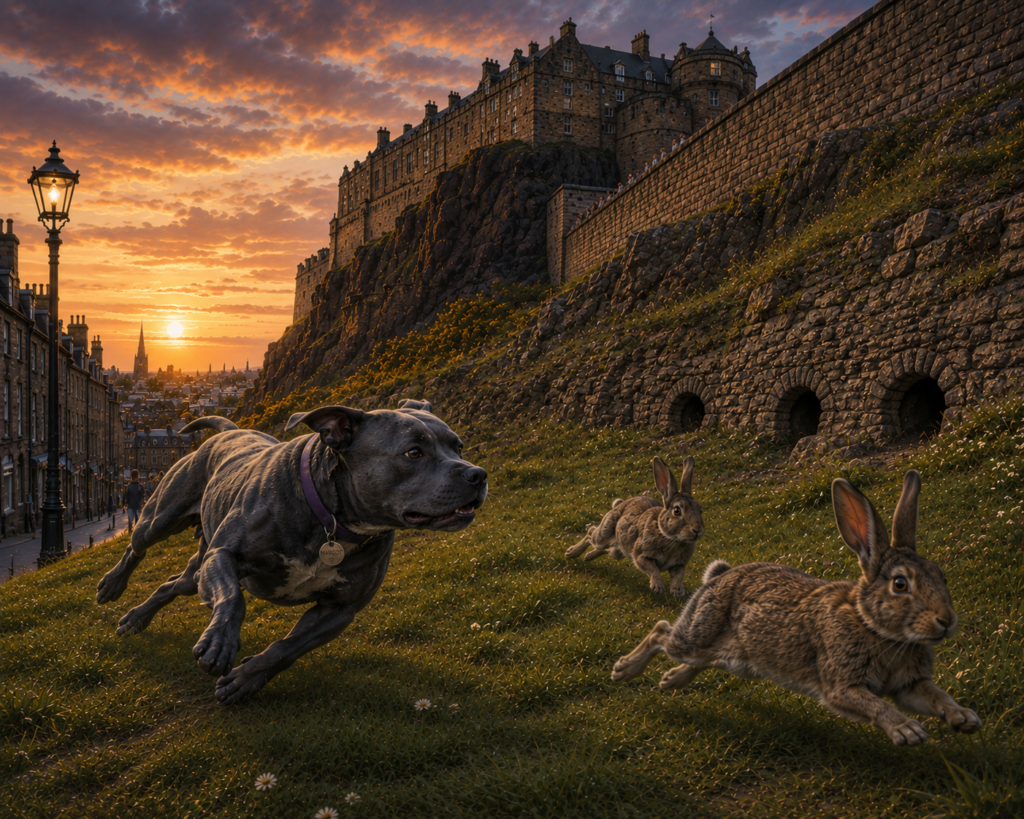
On Johnston Terrace tucked just below the battlements of Edinburgh Castle there is green grassy bank.
A short time ago I happened to be waiting near there on a chauffeur job and glanced up at the rock face, when I noticed some holes. They had the look of rabbit holes about them. But then I looked around — there was the castle above filled with tourists, the Royal Mile a stone’s throw away, the city pressing in on all sides — and I thought, nah surely not. But then a rabbit appeared. And then another…
I found myself genuinely astounded, and also slightly in awe of the sheer optimism of any creature that surveys the very centre of one of Scotland’s great cities and thinks — yes. Here. This is the spot I’m going to set up home.
Last week, Janine and I took Margot camping up at Lunan Bay, just north of Arbroath. And there, in the fields around the campsite, there were rabbits everywhere. Dozens of them. The adults in one field, what appeared to be the younger ones in another — I’ve started calling them bunlets, and I’m not taking that back.
Now, the word bunny is actually Scottish in origin — from the dialect word bun, first used for squirrels in the 1580s before it transferred to rabbits. The deeper root is probably the Scottish Gaelic for bottom or base, referring to the short little tail of the hare. So every time anyone has ever called a rabbit a bunny, they’ve been unwittingly speaking Scots.
Speaking of which — being near Arbroath, I should mention that Scottish fishing communities along this coast had a very particular feelings about rabbits. The word itself was strictly forbidden. Fishermen considered it deeply unlucky, and if you absolutely had to refer to one, you called it a bob tail, a fower fitter, or a mappin. There’s a wonderful account from the North East Folklore Archive of a young lad coming home after a day’s shooting, proudly showing his fisher father the rabbit he’d caught. In his own words he says— this gentle mannie ah’d kent a’ ma life wint aff his heid and accused me o’ bringing him bad luck.
Margot, meanwhile, was encountering her first rabbits. They are a genuine rarity in much of England now, devastated by disease over recent decades. Which made this abundance feel like something worth pausing over.
Margot being Margot did not pause. She launched herself toward them with all the subtlety of a Staffordshire bull terrier in a china shop, which is to say none whatsoever. Lead taut, arms nearly pulled out of their sockets, eyes fixed on creatures that can reach thirty-five miles an hour and change direction in an instant.
A rabbit can outrun a fox. It can outrun a stoat. It was always going to outrun Margot. But you have to admire her commitment. More hope than experience — and sometimes, that’s enough.
A Tale of Two Twitchers
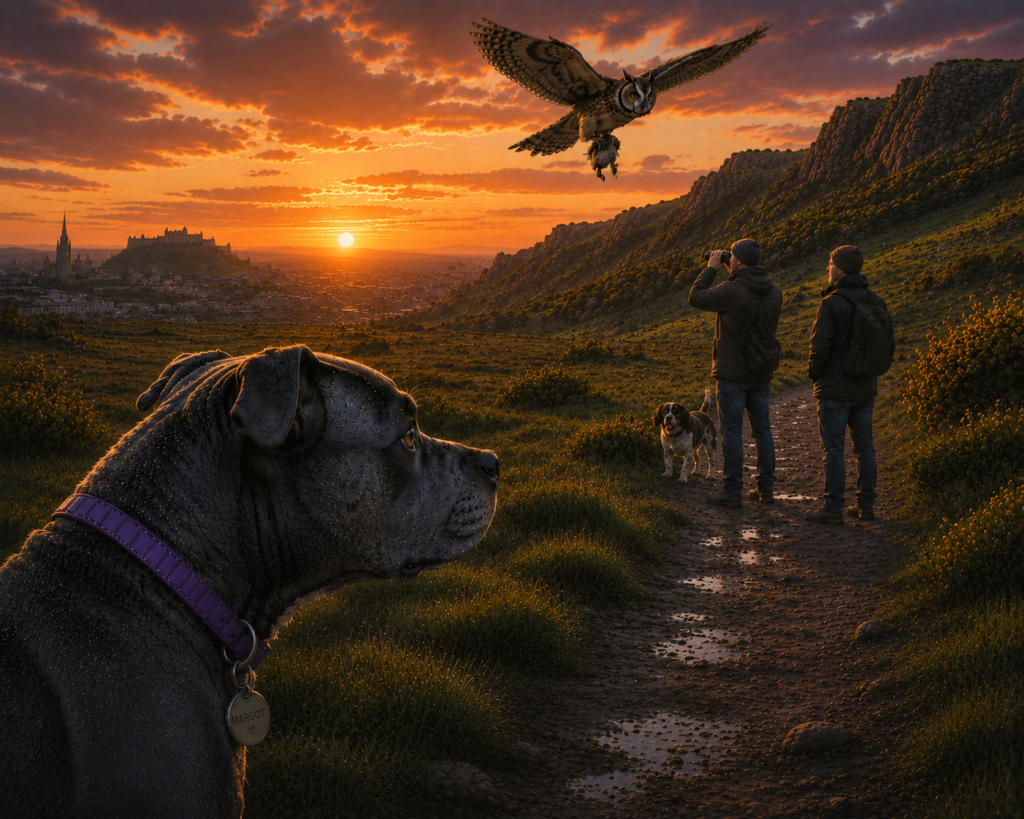
Tuesday evening, and Margot and I decided to make the most of the long nights running up to the summer solstice. I managed to persuade my increasingly reluctant adventuring partner up onto Salisbury Crags — she’s gone a bit lazy lately, and these days whenever I head for the crags she tries to drag me in the opposite direction.
On the way back, passing Hunter’s Bog — the boggy valley that sits between Salisbury Crags and Arthur’s Seat — something caught my attention. There. ……..on the path,…….not fifty metres away………was a bloke staring off into the distance.
Now, as anyone who heard last week’s lawnmower story will know, there is a natural law about this. One bloke watching something will soon become two blokes watching something.
Which got me thinking — there ought to be a proper collective noun for this. Two or more blokes/people, attention fully locked onto the same thing. I’d like to propose a gorm. It turns out gorm is a genuine old word, the root of gormless, originally meaning heed, or attention — from Old Norse, by way of Yorkshire dialect. Somewhere along the way the language kept the “less” and dropped the “gorm,” which feels like a real loss, because a gorm of blokes is exactly what was forming in front of me. Fully attentive. Deeply serious gazing at the same thing.
“An owl just flew over my head,” he announced, pointing into the gathering dusk. We both stared in the general direction of the crags. And then, geek that I am, out came the binoculars.
After a few minutes of patient watching, we were rewarded. The owl came flying back towards us, burdened with a small furry something in its talons, and disappeared into the trees behind us — followed immediately by a chorus of chirps, clucks and cheeps, as a nest full of chicks realised dinner had arrived.
Out came the Merlin app, the geek’s other essential tool. The result was …..drum roll please a long-eared owl. Now, if you know your birds, that is a proper spot — long-eared owls are notoriously secretive, mostly nocturnal, and rarely seen well by anyone, let alone at close range with prey in their talons. Even my dad was impressed, and he’s a committed twitcher of many years’ standing.
But the real joy of the evening wasn’t just the spot itself. It was the moment shared between two complete strangers, briefly united by the same small miracle of nature unfolding in front of them. A proper gorm moment, in the very best sense.
Margot, meanwhile, remained entirely unmoved by world-class wildlife spotting. She had far more pressing business — eyeing up an approaching spaniel with the keen, unwavering focus of a professional trouble maker.
Some of us were there for the owls. Some of us were there for the spaniel. Nature, it turns out, has something for everyone.
Blackbirds sing
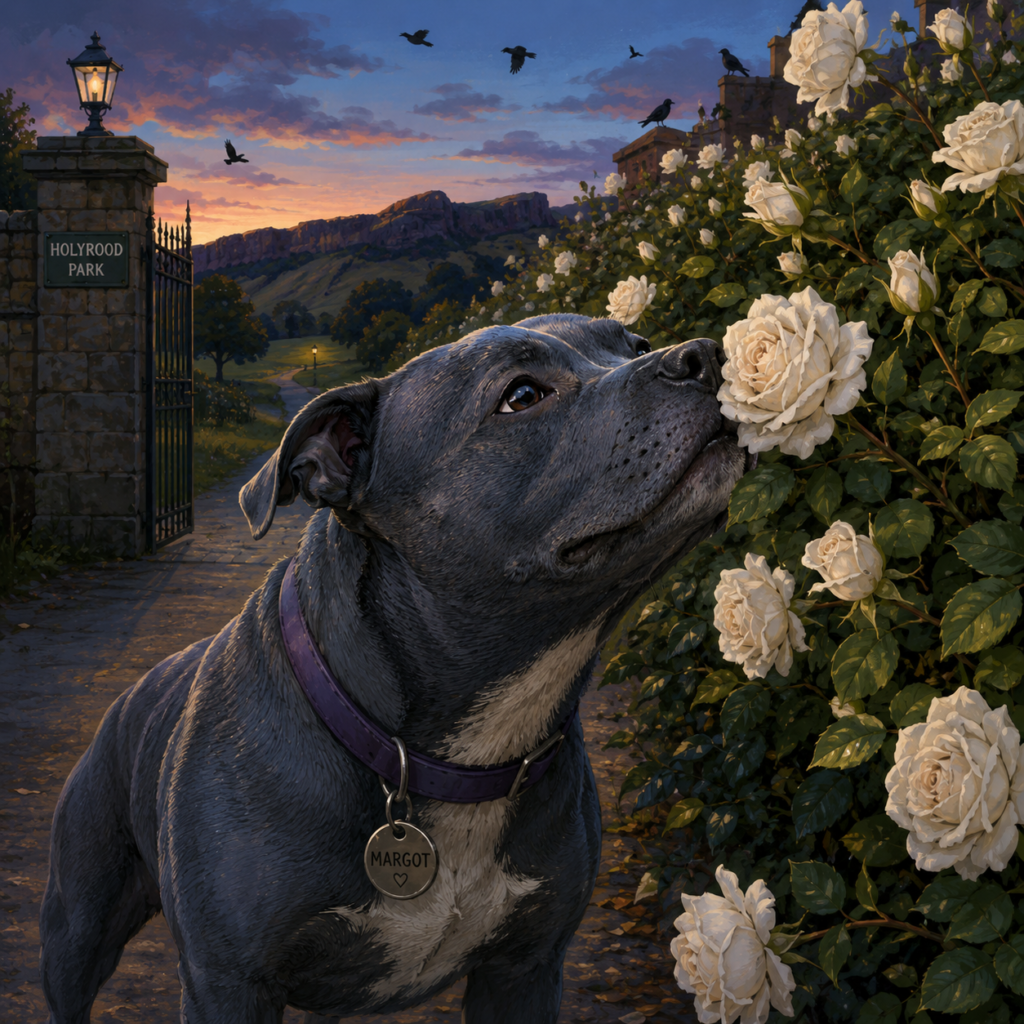
On an evening constitutional with Margot, the shadows were growing long and the blackbirds were doing what blackbirds do at dusk — singing from every rooftop and treetop as if they owned the place.
Just as we turned into the gateway of Holyrood Park, something caught my eye. A hedgerow woven through with white rose flowers. And at that hour, in the cooling air, the scent was extraordinary. Powerful and sweet and fragrant. So I did what any sensible person would do — stopped dead, buried my nose in the nearest bloom, and forgot entirely where I was going.
An old chap nearby was watching me with a smile on his face. Do they smell good? he asked. I told him what I believe to be true — you should always take time to stop and smell the roses.
I love the smell of roses. I’m sure I’m not alone. I have rose-scented Faith in Nature body wash. I am entirely unashamed about my fondness for rose Turkish delight. And years ago, Janine and I on one of our first dates and drove through the night to Alexandra Palace to see Amma — the Indian spiritual teacher sometimes called the hugging saint, who has embraced millions of people around the world. As she drew me in for a hug, there was an unmistakable scent of rose oil, warm and soft. She is famous for it.
The rose has been woven into human mythology for as long as anyone can remember. In Hindu tradition, the god Vishnu formed his bride Lakshmi entirely from rose petals — over a thousand of them. In Celtic folklore, fairies were said to favour roses above all flowers, fashioning crowns and garlands from them. Perhaps fitting that I found them at a gateway — since in the old stories, wherever fairies gather, a threshold between worlds is never far away.
But the rose has always carried a duality. The petal and the thorn. Beauty and sharpness arriving together in the same plant. There is a Buddhist saying I find particularly honest: the stinking pit and the fragrant rose are two aspects of the same existence. Sit with that for a moment. The rose doesn’t apologise for its thorns. It simply offers both, and lets you decide how close you want to get.
Which is perhaps exactly what stopping and smelling the roses is really about. To pause whatever you are doing. To arrive fully in the present moment. To let the senses do what senses are for. Just to stand there in the cooling evening air and let it be extraordinary.
Margot, for her part, had her nose in the hedge for entirely different reasons.
But we both stopped. And that was enough.

Life and death in the same breath
On Thursday evening, after voting, Princess Margot and I set out on our evening walk. It was, depending on your perspective, either a glorious festival of flowers or a hay fever sufferer’s worst nightmare. Periwinkle, bluebell, red campion, clematis. The gorse still doing its luminous thing on Salisbury Crags — there’s a saying that when gorse is out of blossom, kissing’s out of fashion, which means, encouragingly, almost never, since gorse flowers throughout the year.
But presiding over all of it, unmistakably, was the hawthorn. White clouds of blossom in every hedgerow and hillside. The hawthorn is also called the May-tree, which brings us to the old saying: never cast a clout till May is out. A clout, in case you were wondering, is an old word for clothing. The debate about whether “May” means the month or the blossom has been running in newspaper letters pages since at least the 1930s, but the more poetic interpretation holds that you shouldn’t leave your coat behind until the hawthorn is flowering. And there’s sound ecological logic to it: hawthorn is considered a very accurate predictor of the end of frosts — it won’t flower until the danger has passed. The tree itself, in other words, is telling you it’s finally safe.
I do have a soft spot for the hawthorn. In early spring, when it’s just coming into leaf, I like to eat the young shoots as I walk. Apparently I’m in good company: country people used to call this bread and cheese — a free snack from the hedgerow, tender and slightly nutty, tasting of the season just beginning.
But as I was walking I kept catching something on the air — a faint sweetness with a darker edge, something slightly funky and decaying. It turned out to be the hawthorn itself. The blossom contains a chemical called trimethylamine, which is also produced in decaying animal tissue. In earlier centuries, when the dead were laid out at home for several days before burial, people knew that smell intimately. No wonder they considered it bad luck to bring it indoors.
There was something fitting about that, walking with a dog through an Edinburgh evening thick with flowers. Life and death in the same breath. A reminder that May’s abundance isn’t separate from the rest of the cycle — it’s part of it. The hawthorn gives us food, a weather forecast, and a faint smell of mortality tucked inside its blossom. It’s been doing this for a very long time. And sometimes all it takes to feel connected to that long thread of time is a Thursday evening walk, a dog pulling at the lead, and pinning back the senses to notice what’s around you.
Although you don’t necessarily need the dog.
The last snow of the season
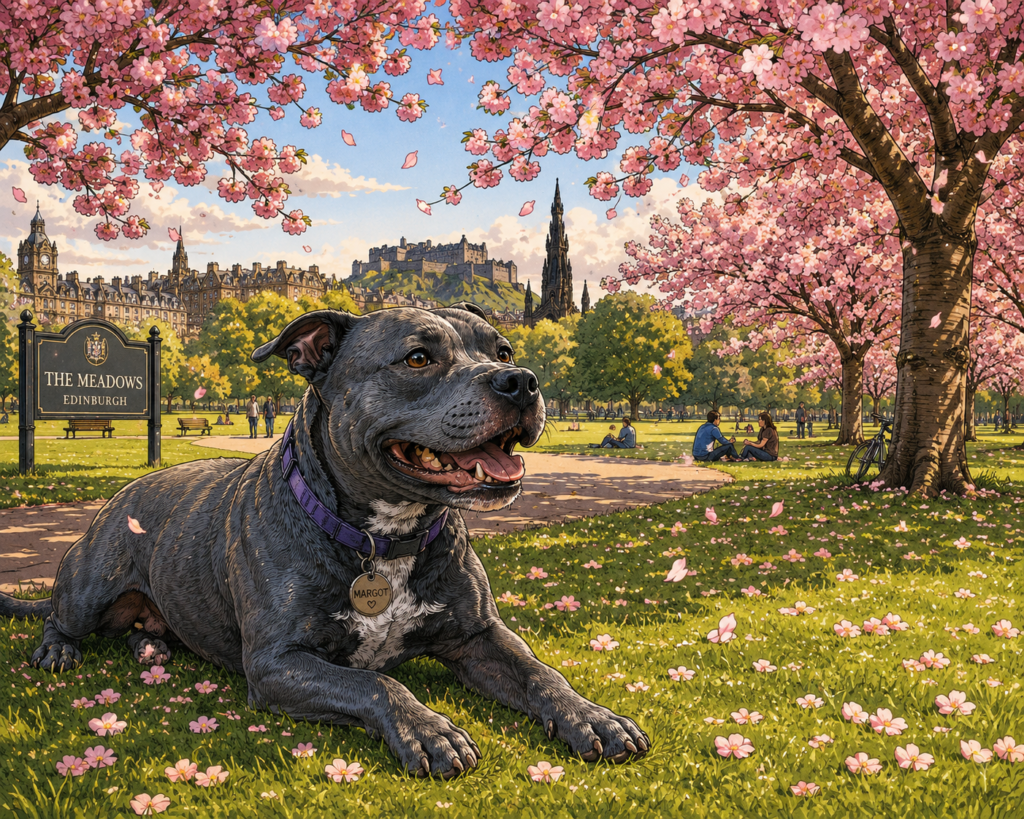
Look up this coming Sunday the 26th of April and you’ll find the moon in her First Quarter phase – just over 70% illuminated and waxing. In the Celtic Tree Calendar, we are deep in the month of Saille — the Willow Moon, running from April 15th to May 12th, pronounced Sahl-yeh. It is deeply tied to the cycles of the moon and water, symbolising adaptability and emotional healing. A fitting moon under which to stand beneath a canopy of pink petals and simply look up.
Because right now, down on The Meadows, one of Edinburghs greatest annual spectacles is in full bloom. The avenue of cherry trees has become a luminous pink tunnel — blossom so dense it seems almost improbable, as though the trees have been saving themselves all winter for exactly this moment. Phones are out, selfies are being taken, children are running through the falling petals, and everyone is smiling. This is Edinburgh doing joy.
There is a lovely expression, likely borrowed from Japanese tradition, that cherry blossom is the last snow of the season. Watch a gust of wind move through the canopy and you’ll understand why — petals lift and drift and spiral down in pale pink flurries, settling on paths and grass in soft drifts. It looks just like snow and is just as fleeting. Gone within days if the wind gets up or the rain moves in. Worth getting out for while it lasts.
Scotland has its own wild cherry too, known as the gean — a name which shares its roots with guigne, the French word for a type of sweet cherry. Geans grow across Scottish woodlands, often appearing singly or in small clusters at the woodland edge, and their spring blossom display gave them a distinctly mysterious quality in Highland folklore. To encounter one was considered auspicious and fateful. There is also the bird cherry — hag berry in Scots dialect — its wilder, more heavily-scented cousin. Folklore from north-east Scotland warned against using bird cherry wood for any purpose, as it was regarded as a witches tree.
In Japan the annual festival of Hanami brings families together to celebrate beneath the blossom every spring, a tradition that honours both beauty and its brevity. And that brevity is the whole point. The Japanese have a phrase for the feeling that cherry blossom reliably produces: mono no aware — pronounced moh-no no ah-wah-reh. It translates most closely the pathos of things, an empathy toward things though neither quite captures it. A looser but perhaps truer rendering is the bittersweet awareness of impermanence — the idea that something is more precious, not less, because it will not last. The thing is, you don’t need to know the word to feel it. Stand under those trees on The Meadows, watch the petals come down, and something shifts — a quiet, almost inexplicable tug that sits somewhere between joy and wistfulness. That’s mono no aware. The Japanese simply had the good sense to name it.
Go soon. The last snow of the season never stays long.
Rosemary
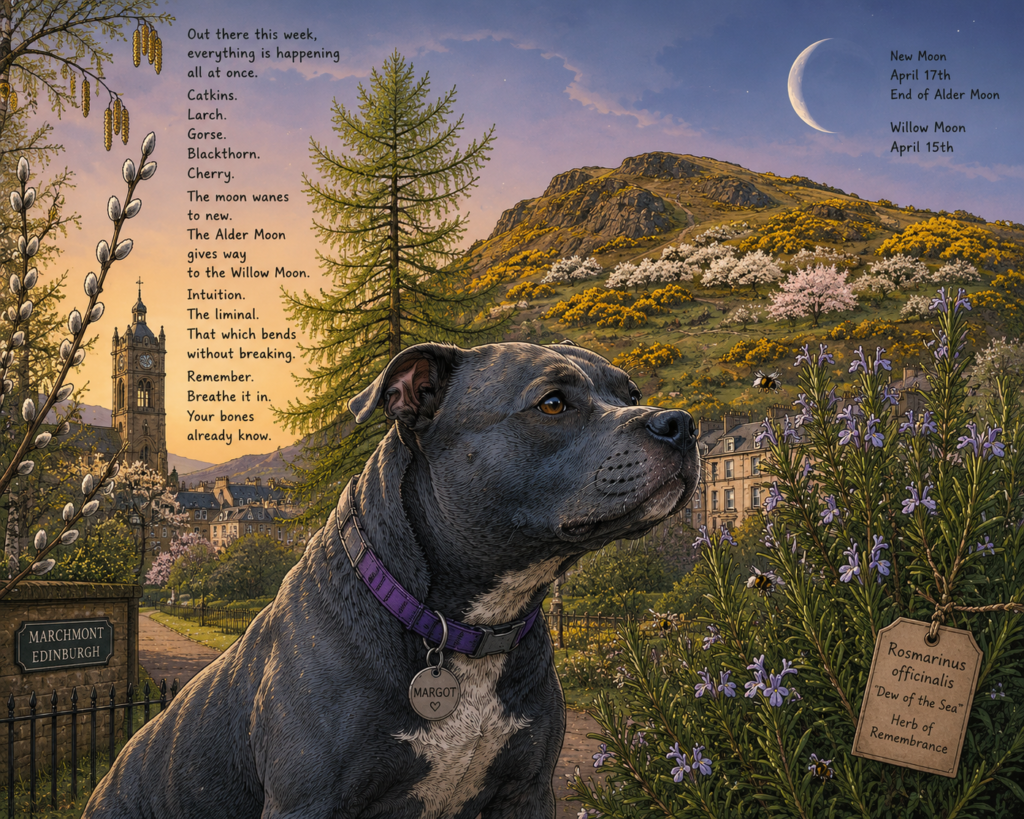
Walking through Marchmont after last Sunday’s I noticed a rosemary bush beginning tentatively to flower. And that same rosemary – a large branch of it – was used by the rector at St Columba’s easter service to splash the congregation with blessed water. I notice she intentionally missed out Janine and I.
Rosemary has always played a part in my life. My mother is called Rosemary. And we played that song: Love grows where my Rosemary goes. Perhaps that is its own kind of old magic. The old name for rosemary is dew of the sea – from the Latin ros marinus, because sea spray would settle on coastal plants like morning dew. The Celts believed the threshold between salt water and fresh was a thin place. Rosemary grew there.
It is the herb of remembrance. In the old stories, it lined the manger where the Christ child lay. Medieval folk scattered it on church floors at Christmas, not just for the scent, but because rosemary kept evil from the door at life’s great passages: birth, marriage, death. When Queen Elizabeth II was laid to rest, rosemary lay upon her casket. And here is the wonder. Science now whispers what the old herbalists always knew: rosemary contains a substance called 1,8-cineole.
Inhale it – brush past a bush, crush a needle between finger and thumb – and it works upon the brain. Studies show it improves cognitive performance and memory speed. It is kin to the medicines used for those who are losing their hold on remembering.
Is it not a beautiful thing? That a plant used for remembrance actually helps the brain to remember. The old world did not need the science. They just walked through the herb garden and breathed.
As the moon fades towards darkness, and the gorse blazes yellow on the crags, may you find your own rosemary.
Breathe it in. And remember what your bones already know.
The Paschal Moon and the Patience of a Staffie
This week, on the second of April, the full moon rose. Not just any moon, but the Budding Moon, the New Shoots Moon, the Seed Moon. Under her light, the countryside sheds its bare bones. What was dormant now stirs: buds break from twigs, and seeds dropped last autumn finally feel the warmth and the lengthening light, cracking open their hulls to begin.
This is also the Paschal Moon—the first full moon after the spring equinox, the ancient clock by which Easter is still reckoned. A moon of threshold and reckoning.
The day of that moon, Margot the Staffordshire bull terrier found a large log in a small, nondescript wood on St Leonard’s Crag. And as anyone who knows a Staffie will tell you, you cannot separate her from a good chew. You simply wait. You wait until the madness of joy runs its course. So I stood, hands in pockets, and surrendered to the waiting.
In that forced pause, I began to see.
There were the flowers of comfrey, nodding bells of cream and mauve, which the old folk called bone mend for their knitter of flesh and sinew. And the fresh, lime-green leaves of hawthorn, so tender you could almost see through them. The ancient Celts named these the bread of the wood, and they are good for the heart—both the muscle and the seat of sorrow. A handful chewed, they say, steadies the pulse.
Above, the ash tree had just begun to flower: tiny brushes of a purple so deep it appears black, as if the tree were writing in ink against the sky.
The birds were singing. I listened properly, not trying to make it pretty. The blue tit made a dry, scratchy tss-tss-tss-tchurr, like someone dragging a twig across grit. The great tit called teacher-teacher — two notes, high then low, metallic and insistent. The bullfinch gave a single soft pewevery few seconds, barely louder than a breath. The chaffinch rattled off a fast, descending chip-chip-chip-chip-trrrr, ending in a flick. The robin sang cheerily, cheer up, cheer up, cheerily, cheer up — a bright, repetitive phrase, each verse slightly different. The dunnock, hiding low in the brambles, produced a thin, hurried jangle — tizz-tizz-tizz-trrr — mechanical, unmusical, easy to miss. And the wood pigeons sat in breeding pairs, big as grey pineapples, absurdly weighing down branches far too small for them, cooing a deep, slow coo-COO-coo, the same three notes over and over.
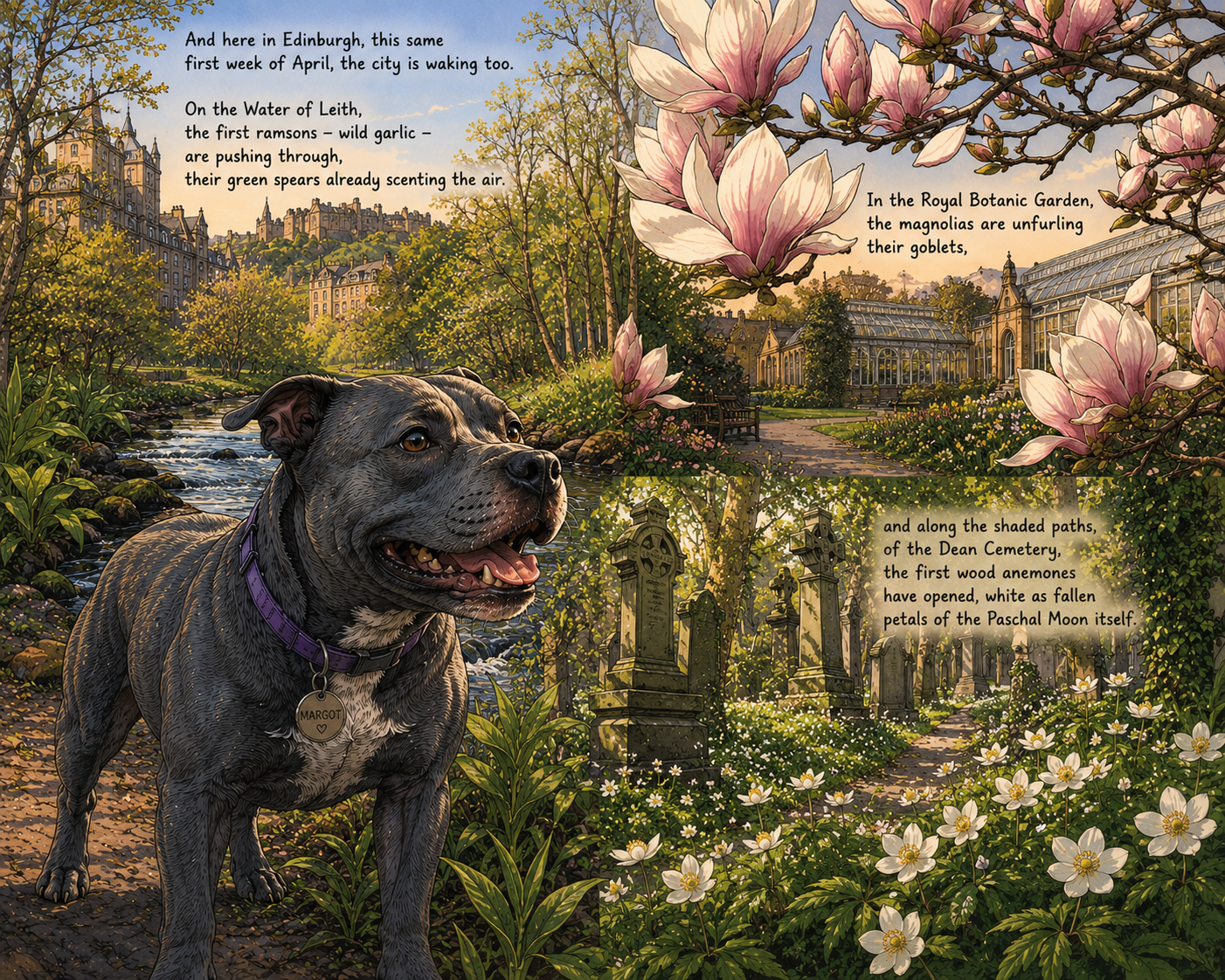
And here in Edinburgh, this same first week of April, the city is waking too. On the Water of Leith, the first ramsons—wild garlic—are pushing through, their green spears already scenting the air. In the Royal Botanic Garden, the magnolias are unfurling their goblets, and along the shaded paths of the Dean Cemetery, the first wood anemones have opened, white as fallen petals of the Paschal Moon itself.
Sometimes, when life—or a Staffie with a log—gives you a forced opportunity to wait, take it. Slow down. Listen. See, really see. Feel the breeze. Feel the early spring sun, still tentative but kind.
The world is not rushing. Only we are.
St Mark's
A place called home
St Mark's Unitarian Church at Castle Terrace, Edinburgh, has been our meeting place for almost two hundred years. We also meet via Zoom and you can connect with us through social media (Facebook and Twitter).
We’d love you to come along to our time together in community any Sunday at 11.00am or to any of our groups, events and activities.